Introduction
EUSS family permit refusal cases involving dependent relatives are rising. In many cases, however, the decision does not reflect a genuine failure of evidence – it reflects a misapplication of the law by the decision-maker. Home Office caseworkers are, with increasing frequency, imposing requirements that simply do not exist in Appendix EU, demanding that financial support be regular, structured, and formally documented in a manner the rules do not require.
This case study presents a real case in which we successfully challenged exactly that kind of unlawful reasoning. Our client’s father had received a dependent parent UK visa refusal under the EUSS Family Permit route. The refusal letter cited “sporadic financial support,” “dependency not demonstrated,” and “insufficient evidence.” Each ground was legally unsustainable. By conducting a full legal audit, restructuring the evidence, and deploying a formal complaint strategy, we managed to overturn visa refusal UK applicants too often accept as final.
If you or a family member has received a similar refusal, this case demonstrates that the end of one decision is not the end of the road.
Case background
Our client – an EU national Confirm settled in the UK under the EUSS, contacted us after his father’s application for an EUSS Family Permit had already been refused. The father resided outside the UK and was financially dependent on our client to meet his essential living needs, including costs associated with a long-term medical condition.
Prior to seeking our assistance, the family had submitted the application without specialist legal support. The supporting evidence included a pattern of international money transfers alongside a personal statement explaining the circumstances of the dependency. Despite this, the Home Office refused the application on three stated grounds:
- Sporadic financial support – the decision-maker characterised the transfers as irregular and therefore insufficient to demonstrate genuine dependency.
- Dependency not demonstrated – the refusal concluded that the financial evidence did not establish that the father was reliant on our client for his essential needs.
- Insufficient evidence – more broadly, the caseworker considered the documentation inadequate to meet the applicable standard.
Each of these conclusions involved a misreading of the legal framework under Appendix EU.
The legal framework: what the Appendix EU dependency requirement actually says
The Appendix EU dependency requirement is widely misunderstood – including, regrettably, by those applying it. The following principles are established in the Immigration Rules and confirmed in case law and Home Office guidance. None of them was applied correctly in this case.
No minimum duration of dependency is required
Appendix EU does not impose any fixed period over which dependency must have existed. Dependency is assessed at the date of application. A person may have become financially reliant on their family member relatively recently, and this does not disqualify them from the route. The absence of a long historical record is not, in itself, a basis for refusal.
No requirement for fixed or regular payments
There is no requirement in Appendix EU – or anywhere else in the Rules – that financial transfers must occur on a fixed schedule. The test is whether the person is genuinely dependent on the EU citizen or their family member for their essential living needs. A pattern of irregular payments dependency UKVI caseworkers so often fixate on is entirely capable of satisfying the dependency test where those payments respond to genuine need. A decision-maker who refuses because payments are “sporadic” has invented a requirement that does not exist.
Dependency is assessed holistically
The correct approach requires the decision-maker to consider all available evidence in the round: the financial transfers, the personal circumstances of the applicant, their living costs, any medical or care needs, and the overall picture of reliance. A refusal that focuses narrowly on the form of payments, while ignoring their purpose and the applicant’s wider situation, does not constitute a holistic assessment and is legally flawed.
The purpose of transfers is material
What matters is not merely that money was sent, but what it was sent for. Producing clear evidence of the essential living needs UK immigration rules require is often the missing piece in refused applications. Transfers directed at covering rent, food, medical treatment, or other essential costs are highly probative of genuine dependency. A decision that disregards the purpose of those transfers is not engaging with the substance of the application.
The core legal question is not whether financial support was provided in a particular way – it is whether the applicant genuinely needs that support to meet their essential living needs. The form of the evidence is secondary to its substance.
Home Office errors in this case
The refusal letter contained a number of legally identifiable errors. Understanding these errors is essential to anyone seeking to challenge Home Office refusal UK decisions of this kind.
Imposing non-existent requirements: The decision-maker required that financial support be provided on a regular basis. This requirement appears nowhere in Appendix EU. Its application rendered the refusal unlawful on its face.
Ignoring the purpose of transfers: The refusal acknowledged the existence of money transfers but made no findings about what those transfers were used for. The applicant’s essential living costs were never addressed.
Failure to assess living costs: No assessment was made of the applicant’s actual income, outgoings, or financial position. Without this analysis, a conclusion that dependency had not been demonstrated was unsustainable.
Absence of holistic evaluation: The medical circumstances of the applicant were noted but not weighed. The decision did not engage with the personal evidence in any meaningful way – it was a formulaic refusal, not a considered assessment.
Our approach
Rather than advising the client to simply reapply with additional documents, we took a structured legal approach designed to address the refusal at its source – the unlawful reasoning – while simultaneously building a stronger evidential case.
- Full legal audit of the refusal. We reviewed the refusal letter in detail against the requirements of Appendix EU, identifying each legal error and the specific paragraphs of the Rules that the decision-maker had failed to apply correctly.
- Identification of misapplied Appendix EU principles. We prepared a formal legal analysis setting out, clearly and precisely, why the requirements imposed by the caseworker had no basis in the Rules and how this had led to an unlawful outcome.
- Restructuring the financial evidence. We worked with the client to reframe and reorganise the existing financial documentation in a way that directly addressed the dependency test – linking each transfer to the applicant’s needs rather than simply presenting bank records in isolation.
- Linking transfers to essential living needs. We obtained and presented evidence of the applicant’s essential expenditure – housing, food, medical treatment – and mapped this directly onto the financial support provided by our client. This was the analytical step the original decision had entirely omitted.
- Incorporating medical and personal circumstances. We ensured that the applicant’s medical condition and its financial implications were properly documented and explicitly addressed within the legal submissions, so that the reviewing officer could not overlook them.
- Demonstrating ongoing dependency. We addressed the temporal dimension of the dependency directly, presenting evidence that the reliance was not a historical matter but a continuing reality at the date of the resubmission.
- Submitting a formal UKVI complaint. Rather than proceeding solely through the application route, we submitted a EUSS complaint, UKVI process allows a formal complaint identifying the legal errors in the original decision. This placed the Home Office on formal notice of the unlawful reasoning and created a written record of the errors.
- Challenging unlawful reasoning directly. Our covering legal submissions confronted the manufactured requirements head-on, citing the applicable Rules and articulating precisely why the original refusal could not stand. We did not seek to work around the decision – we argued that it was wrong.
Outcome
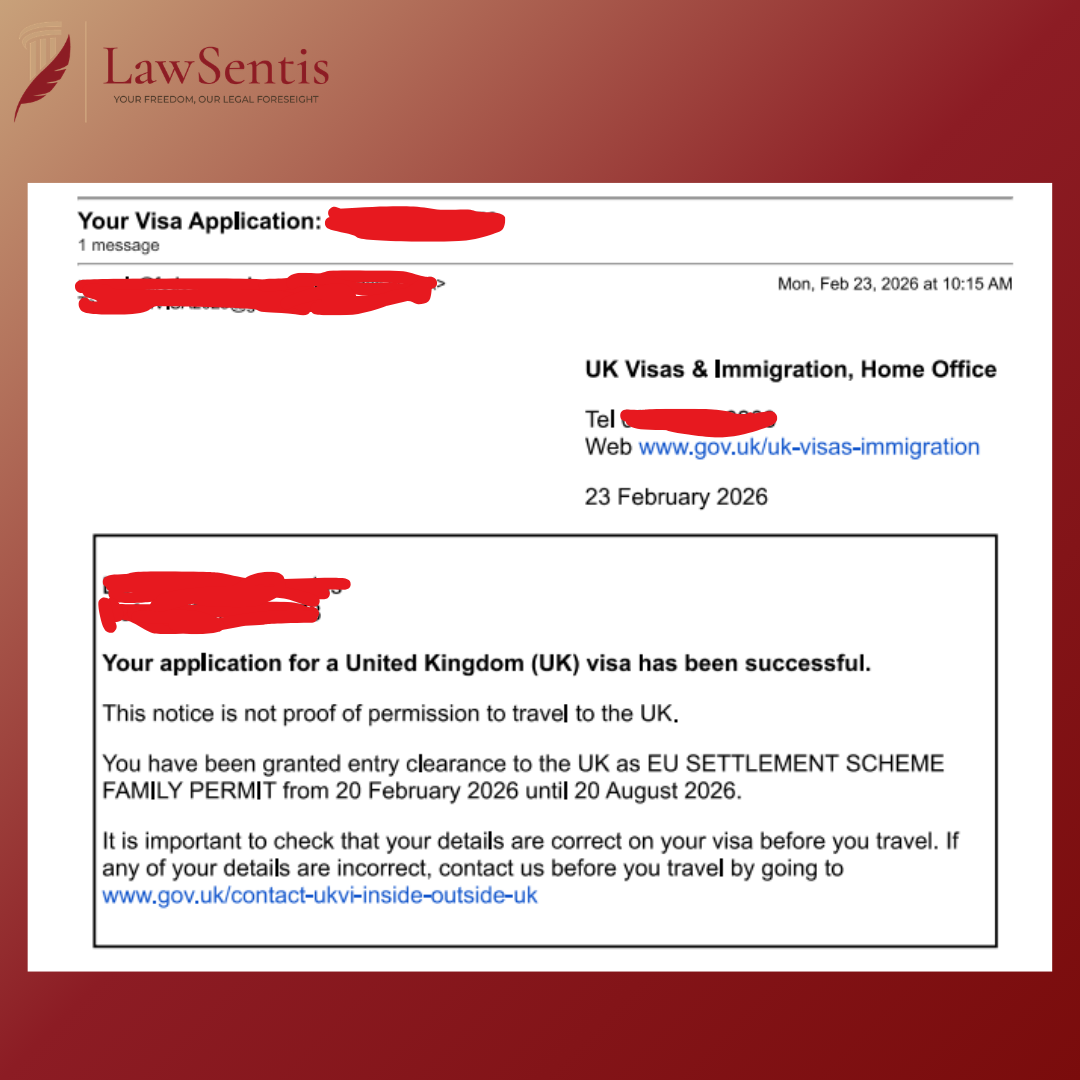
Following our submissions and formal complaint, the matter was reconsidered by the Home Office. The original refusal was effectively overturned and the EUSS Family Permit was granted.
The reconsidered decision included the following finding (anonymised):
“Having considered all the evidence in the round, including the financial transfers and the applicant’s personal and medical circumstances, I am satisfied that the applicant is dependent on [the sponsor] for their essential living needs.”
This was precisely the kind of holistic assessment the Rules had always required. It was not a different decision made on new evidence alone – it was the correct decision made on evidence that should have been engaged with from the outset.
Key insight
Many EUSS refusals arise from legal misinterpretation – not a lack of evidence. Understanding how to prove dependency UK immigration decision-makers are actually required to assess it – holistically, without invented thresholds – is the starting point for any effective challenge. The question is not whether you have enough documents. It is whether the decision-maker applied the correct legal test. If they did not, the refusal can be challenged – and overturned.
Frequently asked questions
What counts as dependency under Appendix EU?
Dependency under the Appendix EU dependency requirement means that the applicant genuinely needs financial support from their EU citizen family member in order to meet their essential living needs. It does not require total financial dependence – partial reliance is capable of satisfying the test, provided it is real and not merely supplementary. The assessment is holistic: financial transfers, living costs, personal circumstances, and any medical or care needs are all relevant. This is a question of financial dependency UK immigration rules address through a facts-based, contextual evaluation – not a checklist.
Do payments need to be regular to prove dependency?
No. There is no requirement in Appendix EU – or in any Home Office guidance – that financial transfers must occur on a fixed or regular schedule. The irregular payments dependency UKVI decisions so often cite as a reason for refusal is not a valid legal basis. What matters is whether the support provided genuinely meets essential living needs. A refusal based solely on the “sporadic” nature of payments applies a requirement that does not exist in the Rules.
Can an EUSS family permit refusal be challenged?
Yes. Where a refusal involves a legal error – such as the application of a non-existent requirement, a failure to carry out a holistic assessment, or a failure to engage with material evidence – there are clear routes to challenge Home Office refusal UK applicants have available to them. These include resubmission with a targeted legal response and a formal complaint to UKVI identifying the specific errors. The key is to identify precisely where the reasoning was wrong, not simply to submit more paperwork.
Is a formal complaint better than reapplying?
In many cases, yes – or at minimum, a complaint should accompany any resubmission. An EUSS complaint UKVI procedure allows the Home Office to be put on formal notice that its original reasoning was unlawful, creates a documented record of the errors, and typically triggers a more senior review. Simply reapplying without addressing the legal deficiencies of the refusal risks receiving the same decision again. The combination of a well-drafted legal resubmission and a targeted formal complaint is, in our experience, the more effective route where legal error is clear.
A refusal is not the end
If you or a family member has received a dependent parent UK visa refusal under the EUSS Family Permit route, the decision may be legally flawed. We specialise in cases where applicants need to overturn visa refusal UK decisions that misapply the dependency test – not through reapplication alone, but through strategy-led legal review that addresses the reasoning at its source.
We handle complex and refused EUSS cases. Contact us to request a confidential case review.
LawSentis is a UK-based immigration firm regulated by the Immigration Advice Authority (IAA) at Level 3, the highest level of authorisation. We provide expert legal advice and representation across all UK immigration routes, including complex cases and appeals.