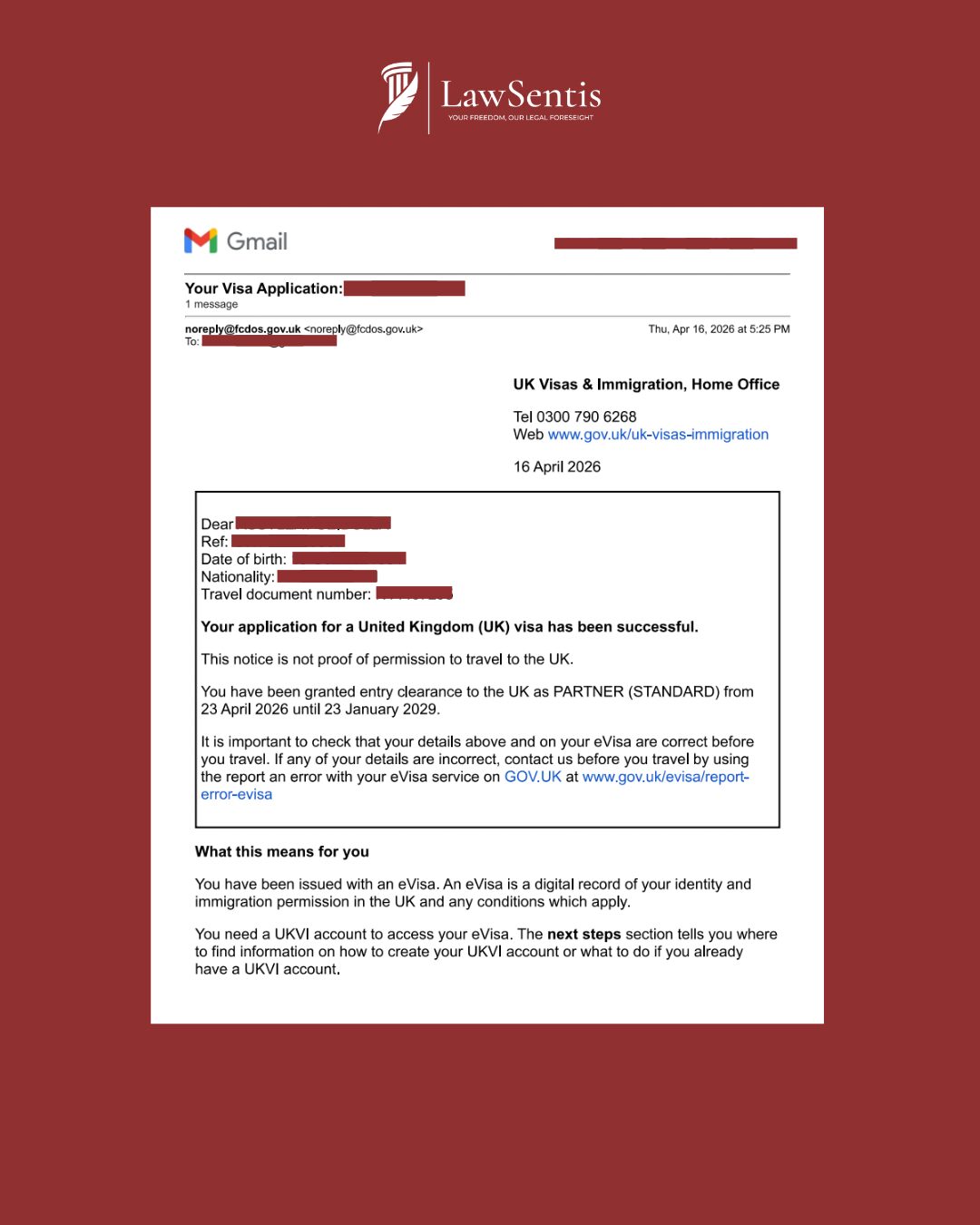
Being on a Tier 5 visa and in a relationship with a British partner does not automatically mean you can stay. Many applicants only discover at the last moment that Tier 5 visa holders cannot switch to a Partner visa inside the UK. This means that when the visa expires, the applicant must leave and apply for entry clearance from overseas. For our client, that meant returning to Kazakhstan and making an overseas application while separated from their partner.
When the client first came to us at Lawsentis, our Immigration Advice Authority (IAA) Level 3 regulated immigration advisers assessed their position carefully. The relationship was genuine, but the evidence was not ready. Cohabitation documents were insufficient, the existing paperwork was inconsistent, and there was no clear evidential strategy in place. With six months remaining before the intended submission date, there was still time to fix that but only with the right approach. This case study explains how structured, long-term preparation secured an unmarried partner visa UK entry clearance approval from Kazakhstan.
Why overseas partner visa applications fail
The unmarried partner visa route sits within Appendix FM of the Immigration Rules. To qualify, an applicant must demonstrate two years of continuous cohabitation and a genuine, subsisting relationship. There is no prescribed list of documents, which means the quality, consistency, and coherence of the evidence package carries everything.
Applications often fail not because relationships are not real, but because evidence is poorly prepared. The most common reasons Entry Clearance Officers refuse overseas partner visa applications include:
- Insufficient or incomplete cohabitation evidence that does not fully cover the required two-year period.
- Inconsistencies between documents, such as different addresses, date discrepancies, and name variations that raise credibility concerns.
- No clear chronological narrative explaining how the relationship naturally developed.
- Evidence submitted in bulk without context or explanation, leaving the caseworker to draw their own conclusions.
- Unawareness of Home Office evidential expectations and what genuinely carries weight.
Our client’s case presented several of these risks at the point of instruction. Left unaddressed, any one of them could have resulted in a refusal.
The evidential challenges in this case
When the client first came to us, their position was more vulnerable than they realised. The cohabitation evidence available did not adequately cover the two-year threshold. Gaps in address history, limited joint correspondence, and insufficient shared financial documentation meant the core requirement under Appendix FM was not yet met on the evidence available.
Beyond the gaps, the existing documents were inconsistent. Different records showed different addresses at overlapping periods. Other documents contained discrepancies that, while innocent in origin, would have created credibility concerns for a caseworker assessing a genuine and subsisting relationship. There was also no chronological account of the relationship, no narrative thread connecting the individual documents into a coherent picture of a shared life.
The client was not aware of how significant these issues were. Without knowing what the Home Office expects to see, it is difficult to know what is missing. That is precisely the gap that early legal advice is designed to close.
How we prepared the case
With six months before the intended submission date, we took a phased, structured approach to building an application package capable of withstanding Home Office scrutiny. Specifically, we:
- Conducted a full assessment of the client’s immigration position, the relationship evidence available, and the gap between the current evidential picture and what Appendix FM required.
- Provided pre-departure advice while the Tier 5 visa was still valid, using the available time to begin strengthening the evidential position before the overseas application clock started running.
- Guided the client and their partner on the specific categories of cohabitation evidence that carry weight with the Home Office, supporting them in obtaining and maintaining that evidence over the months that followed.
- Restructured and reorganised the existing documentation, identifying and addressing inconsistencies while contextualising documents that created credibility risks.
- Built a clear chronological timeline of the relationship from the beginning to the application date, supported by documentary evidence at each stage, giving the caseworker a coherent and credible account of the couple’s shared history.
- Prepared the complete overseas application package from Kazakhstan, including detailed legal representations addressing the Appendix FM requirements directly and preemptively addressing any remaining areas of concern.
The key to this application was not the submission itself, it was everything that happened in the six months leading up to it.
Successful approval from Kazakhstan
Following the submission of the full application package with structured evidence and comprehensive legal representations, entry clearance was granted. The client returned to the UK to continue their life with their partner.
The Home Office was satisfied that:
- The two-year cohabitation requirement was met and clearly evidenced.
- The relationship was genuine and subsisting, supported by a consistent and credible evidence package.
- All documentation was coherent, organised, and supported by a clear chronological narrative.
- The application met all the strict requirements of Appendix FM.
Key takeaway regarding unmarried partner visa preparation
This case makes one thing clear: partner visa refusals happen because evidence is poorly prepared, not because the relationship is not genuine. The relationship in this case was always real. What was missing was the evidential infrastructure to prove it to the standard the Home Office applies.
Six months of preparation was the deciding factor. The same application submitted without that preparation, with inconsistent documents, gaps in cohabitation evidence, and no coherent narrative, would very likely have been refused. A refusal would have meant prolonged separation, additional cost, and the need to rebuild a case that could have been built correctly the first time.
At Lawsentis, we specialise in identifying evidential gaps before they become refusal reasons. If you are on a Tier 5 visa, planning an overseas partner visa application, or concerned about the strength of your evidence, our team can assess your case and advise on the best way forward before a refusal makes preparation harder.
Get expert help with your unmarried partner visa
Are you facing an overseas partner visa application or concerned your evidence may not be strong enough? Don’t let poor preparation cost you months of separation and a refusal on your record. Our experienced immigration advisers have successfully prepared complex partner visa applications by building the evidential foundation the Home Office requires.
Contact us today for an initial consultation. We will review your immigration position, identify any evidential gaps, and build a preparation strategy designed to secure approval the first time. Whether you are yet to apply or have already received a refusal, we can help you move forward with confidence.
Frequently asked questions
Can I switch from a Tier 5 visa to a partner visa inside the UK?
No. Tier 5 visa holders are not permitted to switch to a Partner visa in-country. If you are on a Tier 5 visa and in a relationship with a British or settled partner, you will need to leave the UK when your visa expires and apply for entry clearance from overseas. This makes preparation before departure critical, once you have left, the clock is running and the evidential position you have at that point is what you are working with.
What evidence do I need for an unmarried partner visa?
There is no official prescribed list. However, the Home Office expects clear evidence of two years of continuous cohabitation and a genuine and subsisting relationship. This typically includes joint correspondence sent to a shared address, evidence of shared finances, a detailed personal statement, photographs across the relationship, and communication records. The key is not the volume of documents, it is their consistency and credibility as a complete package.
How long does it take to prepare an unmarried partner visa application?
It depends on the strength of the existing evidence. Where cohabitation evidence is strong and documentation is consistent, preparation may take several weeks. Where there are gaps to close and inconsistencies to address, as in this case, several months of structured preparation may be required. The earlier you seek advice, the more time you have to build the strongest possible case.
What happens if my unmarried partner visa is refused?
A refusal is serious. It will remain on your immigration record and must be declared in all future applications. Depending on the basis of the refusal, options may include reapplication with a strengthened evidence package or an administrative review. The refusal letter will set out the reasons, and those reasons must be directly and comprehensively addressed before reapplying. We strongly recommend taking advice immediately after a refusal, before submitting again.
Is it worth getting legal advice before applying rather than after a refusal?
Yes, and this case illustrates exactly why. Pre-application legal advice allows evidential gaps to be identified and closed before they become refusal reasons. A refusal, by contrast, means a mandatory period of separation, additional costs, a mark on your immigration record, and the need to rebuild a case from scratch. The cost of early advice is a fraction of the total emotional and financial cost of a visa refusal.